
OPINION
CHIHUAHUA · APRIL 2026
Víctor M. Gómez-Céspedes | Mexico’s national expert in circular economy and industrial symbiosis
There is a figure that has shifted the global conversation on circular economy this year. Not the percentage of materials the world manages to recycle — that continues to fall, and I shall come to it — but another: €8.7 trillion in avoidable energy losses, every single year. Heat that dissipates into the atmosphere. Energy converted and wasted before it reaches the process it was meant to serve. Fuel that moves goods without delivering the service for which it was purchased. That is the equivalent of nearly eleven Mexican GDPs, evaporated annually — not through natural disaster or financial crisis, but through the way global industry decided, two centuries ago, that this was simply how things worked.
Add to that €10 trillion in end-of-life waste — products and materials discarded before exhausting their useful life — and €5.2 trillion in infrastructure and machinery deteriorating faster than necessary through underuse or deferred maintenance. The Circularity Gap Report 2026 calls this the Value Gap: the value that the linear economy destroys in silence, year after year, without a single conventional economic indicator recording it as a loss. The total comes to €25.4 trillion annually. Nearly one third of global GDP.
This is not a catastrophe. It is an opportunity. And part of it — a concrete, mapped, engineered portion — has a name: $600 million in industrial symbiosis projects in the state of Chihuahua, Mexico. A project portfolio that the state government itself asked us to build. One that would not have been possible without seven years of fieldwork, genuine European cooperation, and partners who backed this work when nobody in Mexico City was paying attention to the north.
The report nobody wanted to read — until it came with a price tag
To understand what the CGR 2026 represents, one must read it as what it is: the final chapter of a story that began in January 2018, at the World Economic Forum in Davos, when Circle Economy published a figure nobody had anticipated. The global economy was 9.1% circular. Of every hundred tonnes of materials entering the world economic system, only nine returned. The remaining ninety-one: extracted, used once, destroyed. Nature has operated without generating waste for 4.5 billion years. Industrialised humanity has spent two centuries demonstrating that it has not learnt the basic principle.
By 2020, the figure had dropped to 8.6%. Not because of the pandemic — because of structural tendency. That year’s report introduced an uncomfortable thesis: all countries are now developing countries, because wealthy nations must decarbonise radically whilst emerging ones must grow without repeating the linear mistakes of their predecessors. Mexico landed squarely in that second category. Not as a sentence, but as an opening: to build on circular models from the outset, without having to dismantle decades of misguided infrastructure.
The 2021 report became the most-cited in the series. For the first time it was quantified precisely that 70% of global greenhouse gas emissions are linked to material management, not to the energy sector. That finding reframed the entire climate debate: renewable energy alone closes 15% of the emissions gap towards 1.5°C. The circular economy closes the remaining 85%. What had long been treated as peripheral environmental policy was, in fact, the very heart of industrial decarbonisation.
By 2022, between the signing of the Paris Agreement and COP26 in Glasgow, the world had consumed more than 500 billion tonnes of virgin materials. The report was unequivocal: we cannot recycle our way out of this. The 2023 edition documented that five of nine planetary boundaries had already been breached — all linked to linear material use. The 2024 report left diagnosis behind and demanded implementation. The 2025 edition opened up all material flows to reveal that the circularity metric had fallen to 6.9%.
And then came 2026 — which, rather than producing yet another declining percentage, brought something different: an invoice. The Value Gap is not an environmental metric. It is an economic reckoning. And that changed who was listening.
Eight years of reports measuring the same failure. The ninth found the language to make those who control capital finally pay attention.
The money that evaporates — quite literally
The €8.7 trillion in energy losses documented by the CGR 2026 is not an abstract figure. It is the accumulated cost of industrial decisions repeated daily in every plant, every industrial park, every supply chain that operates as though resources were infinite and free.
The report breaks energy losses into three stages. During the extraction of primary energy — coal, oil, gas — €1.1 trillion is lost to venting, spills, and inefficient processes. In the conversion and transport of that energy towards the processes that require it, a further €2.6 trillion dissipates as heat, pipeline leakage, and transmission losses. And at the point of final use — in buildings, transport, and industry — an additional €4.9 trillion is destroyed, principally as waste heat from metals production, cement, chemicals, and manufacturing.
That industrial waste heat is precisely what we have been identifying, plant by plant, in Chihuahua. Not in reports — in real facilities. Processes operating at 200, 300, 400 degrees Celsius, discharging that heat to the atmosphere because nobody designed the system to capture it. Heat that could preheat feedstocks, generate process steam, supply cooling systems, or be transferred to a neighbouring company that needs it. Value disappearing through the chimney — which, for the first time, the world’s most important circular economy report has now priced.
What we call industrial symbiosis, the CGR 2026 calls €8.7 trillion in energy opportunity. The vocabulary differs. The problem is identical.
The real obstacle: not technology, not finance — mindset
Here is the part that reports do not say — but seven years of fieldwork teach.
The most stubborn barrier in industrial symbiosis is neither technical nor financial. It is behavioural. And it manifests in ways that no business model anticipates.
The first obstacle is trust. A company does not share its energy consumption data, waste generation figures, or water flows with just anyone. Doing so means exposing internal inefficiencies that the plant manager would rather not document, revealing environmental liabilities that the legal department prefers to keep quiet, and opening a conversation about waste that the CFO will read directly as evidence of poor operational management on his watch.
But there is a second obstacle, subtler and more powerful: when a company finally agrees to examine its surplus resources, the first instinct is not to share them — it is to claim them. When we identify waste heat that could be transferred to a neighbour, the immediate response is not to call the neighbour. It is to ask how that heat might first be used internally. That is not selfishness — it is short-term economic rationality. And in many cases it is correct: internal efficiency is the first step of industrial symbiosis. The problem arises when that first step never leads to the second.
And then there is the obstacle that concerns me most, because I encounter it with increasing frequency and frustration: companies with immaculate sustainability reports that do not, in practice, properly segregate their industrial waste streams. European companies operating in Mexico, managed by Mexican teams who know perfectly well what the standard looks like at headquarters — and who decide, on the ground, that the local waste management budget does not stretch to doing it properly. The sustainability report is published in Amsterdam or Frankfurt. The waste segregation decision is made in Chihuahua, in Monterrey, in Guanajuato. And in that gap between discourse and practice, it is not only material value that is lost — it is the credibility of the entire model.
A sustainability report is not a sustainability policy. That difference shows up in the waste container, not in the annual review.
The change required is not incremental. It is systemic and systematic. Systemic because it must reach the entire architecture of how companies value their resources — not just the environmental team, but finance, operations, logistics, and the board. Systematic because it must be delivered with methodology, with data, with metrics that speak the language of business. Not the language of decorative sustainability.
This is precisely where industrial symbiosis enters as a management discipline — not as a corporate social responsibility programme. When a company sees that its waste heat has a concrete monetary value, that its process water has a measurable replacement cost, that its by-products carry a documented market price — the conversation changes. And when the conversation changes, decisions follow.
What we built — and with whom
In 2019, I went to knock on the door of the Delegation of the European Union in Mexico. I was not invited. I went with a proposal: as chairman of the Energy and Environment Committees at COPARMEX Chihuahua, I put it to them that northern Mexico needed a serious space for circular economy — not an academic forum, but a territorial laboratory. The Delegation listened. And responded.
What we built together from that point — first as Chihuahua Green City, now as Chihuahua Green — was precisely that: a laboratory. Company by company, waste stream by waste stream, energy flow by energy flow. Not through declarations of intent, but through applied engineering and the patience that building trust requires in an industrial community unaccustomed to being asked where it might become more efficient.
We have never worked alone. Simbiosy, a Spanish company that transformed the way industrial territories are analysed through the lens of symbiosis, has been our most consistent technical partner. Together we developed the methodology that converts industrial data into concrete business opportunities. Today, with Simbiosy Global present in Mexico and Latin America, that methodology has the capacity to scale. European expertise in circular ecosystem management, combined with the territorial knowledge we have accumulated in Chihuahua, is a combination few initiatives in Mexico can replicate.
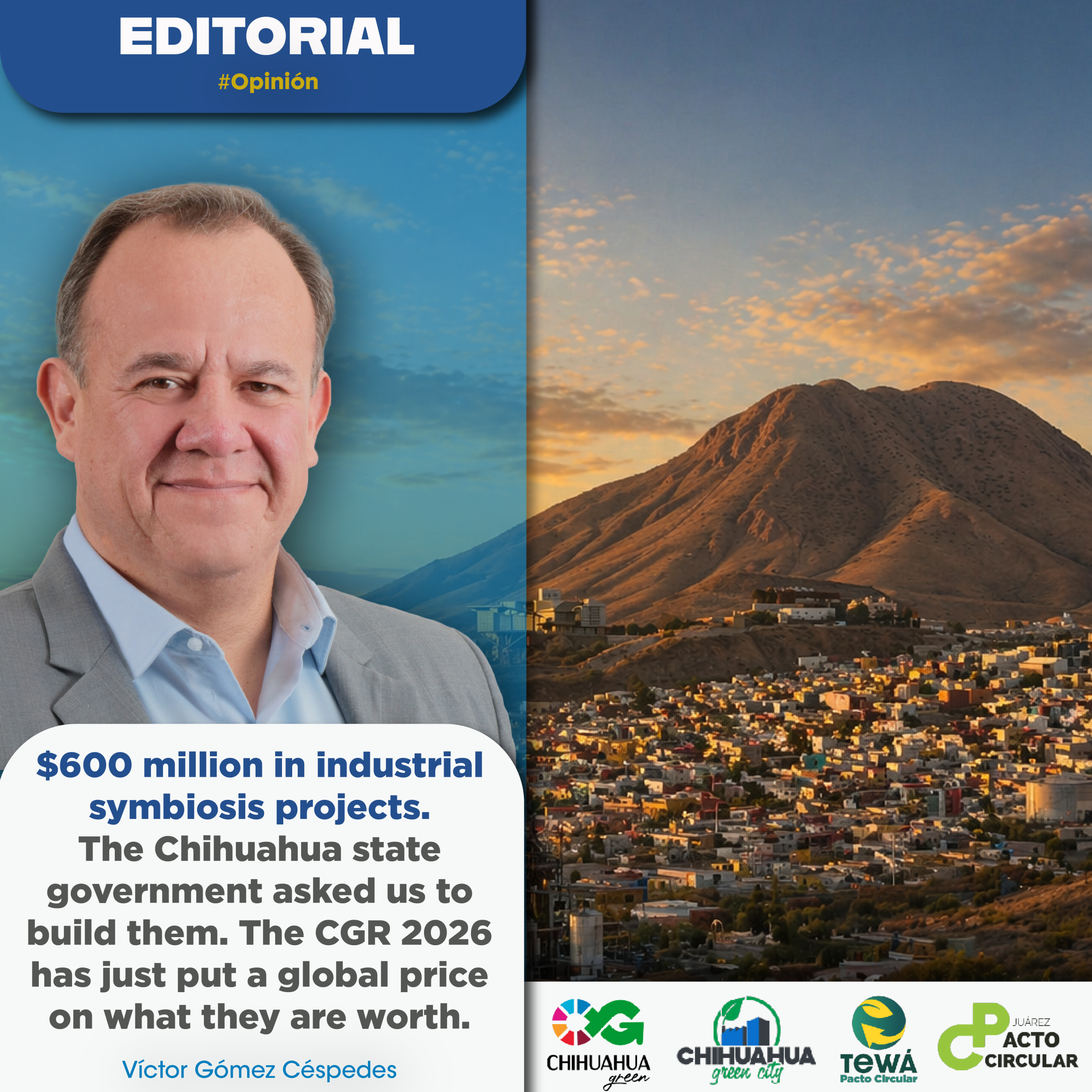
Seven years of work produced a portfolio that the Chihuahua state government itself asked us to build: $600 million in industrial symbiosis implementations, identified with technical detail sufficient to be presented to international development finance institutions. These are not speculative projects. They are opportunities with a company name, a quantified flow, a calculated return, and documented triple impact: economic, environmental, and social.
That is precisely what the CGR 2026 calls opportunity. And precisely what institutions such as the IDB, IFC, and European climate funds are searching for: projects that do not need to be convinced of their viability, but financed to scale.
The talent pipeline the industry is already funding
The circular economy cannot scale without professionals who know how to implement it in the field. Mexico does not have them in the numbers or with the profiles that industry requires. This is why we are building, through the Chihuahua Green University Network, a model grounded in real market demand: the companies participating in our industrial symbiosis processes have agreed to fund scholarships for students with specific technical profiles, including site visits to live operations and a genuine prospect of employment thereafter.
The regulatory trigger already exists: Mexico’s General Law on Circular Economy will require companies to produce circular economy management plans for materials. That creates a substantial demand for profiles that do not yet exist in the Mexican labour market. We are building the pipeline before the wave arrives.
The standard Mexico needs — and the mistake it must not make
All of the accumulated methodology — flow mapping, trust protocols, implementation architecture, applied engineering — is documented in the Industrial Symbiosis Manual whose foundation is Chihuahua Green. This is not an academic document. It is a technical instrument tested in the field with real companies. The EU Delegation in Mexico, through its technical cooperation programmes, has commissioned its national dissemination.
That commission carries an implicit condition that cannot be ignored: effective implementation of the Manual requires state governments that choose to be partners, not bystanders. Mapping real industrial flows is an uncomfortable conversation. Chihuahua had it because its government chose to participate. Not every state is ready for that. But those that are hold a genuine competitive advantage over those that wait.
The Manual should become a national standard with the rigour of a technical norm — ISO-equivalent — and the General Law on Circular Economy should serve as the lever to make it binding within the Circular Economy Poles promoted by federal policy. But there is a risk here that must be named plainly: if those poles are built around Refuse-Derived Fuel as their central axis, Mexico will have invested in the last link of the chain whilst leaving the first links entirely intact. RDF takes what has no other destination and burns it to recover energy. It is the end of the road, not the beginning of transformation. A circular economy pole organised around RDF is not building industrial symbiosis — it is building a more efficient waste disposal system. The difference is not semantic. It is strategic.
Value does not sit at the end of the chain. It sits in every step we decide not to take before arriving there.
IURC-LAC: when the work speaks for itself
Seven years of territorial work built something that no positioning campaign can manufacture: international standing earned among peers. Chihuahua Green is now part of the IURC-LAC programme — the International Urban and Regional Cooperation initiative for Latin America and the Caribbean — of the European Union, alongside Greater Porto (Portugal), Hunedoara (Romania), and Valle del Cauca (Colombia). The most ambitious cooperation network between Europe and Latin America in circular economy and territorial development.
In September 2026, Cuauhtémoc, Chihuahua, will host those delegations for Study Visit 2 of the programme. The tricultural communities of Cuauhtémoc — Mennonite, Rarámuri, and Mexican — are the most distinctive social characteristic of the entire IURC-LAC programme and are explicitly recognised in the Regional Cooperation Action Plan. Because the circular economy we are building here does not abstract away from the territory in which it operates. It draws from it.
Chihuahua is the only region or city in Mexico with a Study Visit in the IURC-LAC 2025–2027 programme. A Study Visit is not a courtesy call — it is a formal mechanism that positions a region as a reference case for future calls, funds, and European partnerships. That is not managed. It is earned.
What comes next
The €25.4 trillion Value Gap that the CGR 2026 documents is not a distant problem. It is a precise description of what happens in the industrial parks of Chihuahua, Monterrey, and Guanajuato — in every plant where waste heat goes up the chimney, in every warehouse where by-products await a waste collection lorry, in every company that publishes a sustainability report and fails to segregate its waste streams properly because this week’s budget does not allow for it.
The change will not come from reports. It will come from those who decide that the language of business and the language of circularity are the same language — and who build the infrastructure to demonstrate it.
We have spent seven years building that infrastructure from Chihuahua. With European methodology, with partners who have continued to back the work, with companies that opened their data, and with a state government that chose to be a protagonist. Without being in Mexico City. Without waiting for anyone to decide the moment had arrived.
The market exists. The projects are identified. The partners remain committed. The question is who decides to enter.
Víctor M. Gómez-Céspedes — Mexico’s national expert in circular economy and industrial symbiosis.
Chief Executive, Recilogic Industrial Company · Team Leader, Chihuahua Green
#ChihuahuaGreen #ChihuahuaGreenCity #COPARMEXChihuahua #IURCLAC #IndustrialSymbiosis #CircularEconomy #EuropeanUnion #Mexico #ValueGap #CGR2026
Sources: Circularity Gap Report 2019, 2020, 2021, 2022, 2023, 2024, 2025 and 2026 — Circle Economy / Deloitte. Full series available at circularity-gap.world